
myetutorstheem

Thursday, 17 February 2022

Friedel craft alkylation reaction

Friedel craft alkylation reaction

In this Friedel craft alkylation reaction Arenes, an alkyl group is introduced on the benzene or arene ring by using the alkyl halide in presence of anhydrous AlCl3. The reagents can be represented as

  1. Anhydrous AlCl3
  2. Anhydrous FeCl3
  3. BF3
  4. TiCl3
  5. ZnCl2
  6. SnCl4

The mechanism of the reaction starts with the formation of an Alkyl carbonium ion. Alkyl halide reacts with anhydrous AlCl3 and acts as a halogen carrier to produce an alkyl carbonium ion (electrophile). The stability of an alkyl carbonium ion is important. 
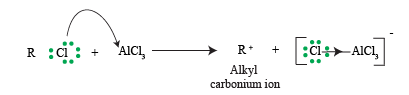
Friedel craft alkylation reaction
The alkyl carbonium ion formed reacts with an aromatic ring to produce resonating forms of the arene. This positive charge on the aromatic ring a stabilized by resonating forms.
In resonance hybrid structure the positive charges are distributed over five carbon atoms so relative positive charge density on each carbon atom is very less and thus it is stabilized.
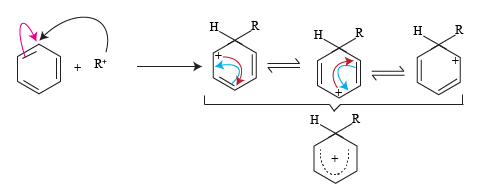
Friedel craft alkylation reaction
The structure three formed in the resonating forms further stabilizes to give a mono-substituted alkyl derivative.
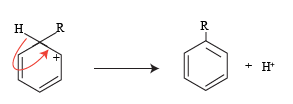
Friedel craft alkylation reaction
The H+ ion release in this reaction joins with the conjugate base to form a byproduct here it is termed as spent acid.
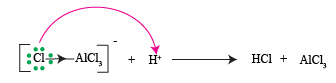
Friedel craft alkylation reaction
The monosubstituted derivative of arenes uses an alkyl halide to give the monosubstituted derivative. While deciding the product of alkylation stability of the carbonium ion formed is to be taken into account. As shown in the examples 


Check out reactions

Chlorination Reaction Bromination Reaction Nitration Reaction
Sulphonation Reaction Friedel Craft Alkylation Reaction Friedel craft Acylation Reaction


You may also like

Nucleophilic Substitution reaction Free Radical substitution reaction Electrophilic addition reaction Free radical addition reaction
Nucleophilic addition reaction Elimination reaction Bond Fission  


Our other courses

Chemistry XII Mock Test XI Mock Test XII  
Mock Test NEET Mock Test JEE Mains Science class 9  


CBSE Chemistry syllabus


https://www.myetutors.com/?p=15745&feed_id=86

Friedel craft alkylation reaction

Friedel craft alkylation reaction

In this Friedel craft alkylation reaction Arenes, an alkyl group is introduced on the benzene or arene ring by using the alkyl halide in presence of anhydrous AlCl3. The reagents can be represented as

  1. Anhydrous AlCl3
  2. Anhydrous FeCl3
  3. BF3
  4. TiCl3
  5. ZnCl2
  6. SnCl4

The mechanism of the reaction starts with the formation of an Alkyl carbonium ion. Alkyl halide reacts with anhydrous AlCl3 and acts as a halogen carrier to produce an alkyl carbonium ion (electrophile). The stability of an alkyl carbonium ion is important. 

Friedel craft alkylation reaction
The alkyl carbonium ion formed reacts with an aromatic ring to produce resonating forms of the arene. This positive charge on the aromatic ring a stabilized by resonating forms.
In resonance hybrid structure the positive charges are distributed over five carbon atoms so relative positive charge density on each carbon atom is very less and thus it is stabilized.

Friedel craft alkylation reaction
The structure three formed in the resonating forms further stabilizes to give a mono-substituted alkyl derivative.

Friedel craft alkylation reaction
The H+ ion release in this reaction joins with the conjugate base to form a byproduct here it is termed as spent acid.

Friedel craft alkylation reaction
The monosubstituted derivative of arenes uses an alkyl halide to give the monosubstituted derivative. While deciding the product of alkylation stability of the carbonium ion formed is to be taken into account. As shown in the examples 


Check out reactions

Chlorination Reaction Bromination Reaction Nitration Reaction
Sulphonation Reaction Friedel Craft Alkylation Reaction Friedel craft Acylation Reaction


You may also like

Nucleophilic Substitution reaction Free Radical substitution reaction Electrophilic addition reaction Free radical addition reaction
Nucleophilic addition reaction Elimination reaction Bond Fission  


Our other courses

Chemistry XII Mock Test XI Mock Test XII  
Mock Test NEET Mock Test JEE Mains Science class 9  


CBSE Chemistry syllabus


https://www.myetutors.com/?p=15745&feed_id=81

Wednesday, 16 February 2022

Reaction Intermediate

Reaction IntermediateReaction Intermediate:   In,  organic ... https://www.myetutors.com/?p=15706&feed_id=66 #cbse #jee2022 #neet2022 #chemistry #exam

Bond Fission

https://www.myetutors.com/?p=15663&feed_id=49

Tuesday, 15 February 2022

title link content_short_40

Homolytic and Heterolytic fission

Homolytic and Heterolytic fission:

Bond fission is the process of breaking covalent bonds present in organic molecules. It occurs in the following two ways

Homolytic and Heterolytic fission

Homolytic fission:

Bond fission occurs symmetrically, and shared electrons between two elements are equally distributed between them to form atoms or free radicals.

Heterolytic fission: 

Bond fission occurs unsymmetrically, and shared electrons between two elements are not equally distributed between them. This fission results in the formation of 

  1.  Electrophiles
  2. Nucleophiles

Homolytic and Heterolytic fission

Electrophiles:

Electrophiles are electron-deficient species that have a tendency to take up electrons, and therefore, they act as Lewis acids.

These are of the following types:

Positively Charged Electrophiles :

H+, X+ , R+, NO2+, NO+, SO3H+.

Neutral electrophiles:

These are of the following types:

Neutral electrophiles with an incomplete octet state have a central atom that is electron deficient, that is, it does not have an octet state.
For example, BeX2, ZnCl2, BH3, BX3, AlX3, FeX2

Neutral electrophiles with an extended octet state have a central atom with a vacant d-orbital, which can extend its octet state. For example, SnCl4, PCl5, IF7

Nucleophiles:

Nucleophiles are species that have lone pairs of electrons, available for donation, and therefore, they act as Lewis bases.


These are of the following types:


Negatively charged:

H, OH, R, O, CH3, X, SH, R, S.


Neutral:

The central atom with lone pair of electrons to donate. For example,
NH3  (RNH2,  etc.)
O (H2O, HOR, R – O – R)
S (R–SH, R– S– R, H2S)

Ambidentate nucleophiles

They have two nucleophilic centers, one of which is negatively charged and the other one is neutral.
For example, C≡N, O−N=O, NO2


You may also like

Nucleophilic Substitution reaction Free Radical substitution reaction Electrophilic addition reaction Free radical addition reaction
Nucleophilic addition reaction Elimination reaction Bond Fission  


Our other courses

Chemistry XII Mock Test XI Mock Test XII  
Mock Test NEET Mock Test JEE Mains Science class 9  


CBSE Chemistry syllabus

http://www.myetutors.com/?p=15664&feed_id=29

Monday, 14 February 2022

Sulphonation reaction Arenes

Sulphonation reaction Arenes:


in this Sulphonation reaction Arenes, a sulphonic acid group is introduced on the benzene or arene ring by using the concentrated sulphuric acid or oleum. The reagents can be represented as

  1. Concentrated H2SO
  2. Concentrated H2SO+ SO3
  3. Oleum

There is equilibrium between concentrated sulphuric acid and Sulphur trioxide.

sulphonation of arenes

the mechanism of the reaction starts with the formation of Sulphur trioxide gas. Protonation of Sulphur trioxide occurs by forming sulphonium ion, this is due to the fact that there is two dπ-dπ bonds in Sulphur trioxide. These bonds are weak bonds and readily react with a proton to form a sulphonium ion (an electrophile). 

Sulphonation reaction Arenes
the sulphonium ion formed reacts with an aromatic ring to produce resonating forms of the arene. This positive charge on the aromatic ring a stabilized by resonating forms.
In resonance hybrid structure the positive charges are distributed over five carbon atoms so relative positive charge density on each carbon atom is very less and thus it is stabilized.

Sulphonation of arenes
The structure three formed in the resonating forms further stabilizes to give mono substituted Sulpho derivative.


The H+ ion release in this reaction joins with the conjugate base to form a byproduct here it is termed as spent acid.

H+  + HSO4 -1 → H2SO4
The monosubstituted derivative of arenes uses a Fuming sulphuric acid always uses a higher concentration of SO3 as it is a hygroscopic material and it absorbs water formed in the first step as a result of which more forward reaction takes place and concentration often Sulphonium ion increases the reaction mixture thus the rate of reaction increases and formation of product is higher yield.


Check out reactions

Chlorination Reaction Bromination Reaction Nitration Reaction
Sulphonation Reaction Friedel Craft Alkylation Reaction Friedel craft Acylation Reaction


You may also like

Nucleophilic Substitution reaction Free Radical substitution reaction Electrophilic addition reaction Free radical addition reaction
Nucleophilic addition reaction Elimination reaction Bond Fission  


Our other courses

Chemistry XII Mock Test XI Mock Test XII  
Mock Test NEET Mock Test JEE Mains Science class 9  


CBSE Chemistry syllabus

https://www.myetutors.com/?p=15693&feed_id=16

Reaction Intermediate

Reaction Intermediate:

In,  organic chemistry there are four types of reaction intermediates that are formed during the reaction. These are formed due to bond fission. There can be Homolytic or heterolytic fission to form intermediates as discussed below


Carbon-free radical:

This is formed by homolytic fission on the bond. The homolytic fission of bond forms four types of the classical intermediate they are methyl carbon free radical, primary carbon-free radical, secondary carbon free radical, and tertiary carbon free radical. They are as shown below

Reaction Intermediate

Criteria of stability:

Stability of Carbon-free radical  ∝  Resonance

                                                          ∝ Electron releasing groups

Order of Stability:

Reaction Intermediate

Carbonium ion or Carbocation:

This is formed by a heterolytic fission bond. The heterolytic fission of bond forms four types of the classical intermediate they are methyl carbocation, primary carbocation, secondary carbocation, and tertiary carbocation. The other type of carbonation is nonclassical carbocation. They are as shown below

Reaction Intermediate

Criteria of stability:

Stability of Carbocation  ∝  Resonance

                                              ∝  Electron releasing groups

Order of Stability:

Carbanion ion:

This is formed by heterolytic fission on the carbon-carbon bond. The heterolytic fission of bond forms four types of the classical intermediate they are methyl carbanion, primary carbanion, secondary carbanion, and tertiary carbanion. The other type of carbanion is nonclassical carbocation. They are as shown below


Criteria of stability:

Stability of carbanion  ∝  Resonance

                                        ∝  Electron releasing groups

Order of Stability:


Carbene:

This is formed by heterolytic or hemolytic fission on the bond. The heterolytic fission of bond forms two types of the intermediate they are singlet carbene and triplet carbene.  They are as shown below


Criteria of stability:

Stability of carbanion  ∝  Resonance

                                        ∝  Electron releasing groups

Order of Stability:


You may also like

Nucleophilic Substitution reaction Free Radical substitution reaction Electrophilic addition reaction Free radical addition reaction
Nucleophilic addition reaction Elimination reaction Bond Fission  


Our other courses

Chemistry XII Mock Test XI Mock Test XII  
Mock Test NEET Mock Test JEE Mains Science class 9  


CBSE Chemistry syllabus

https://www.myetutors.com/?p=15706&feed_id=7